

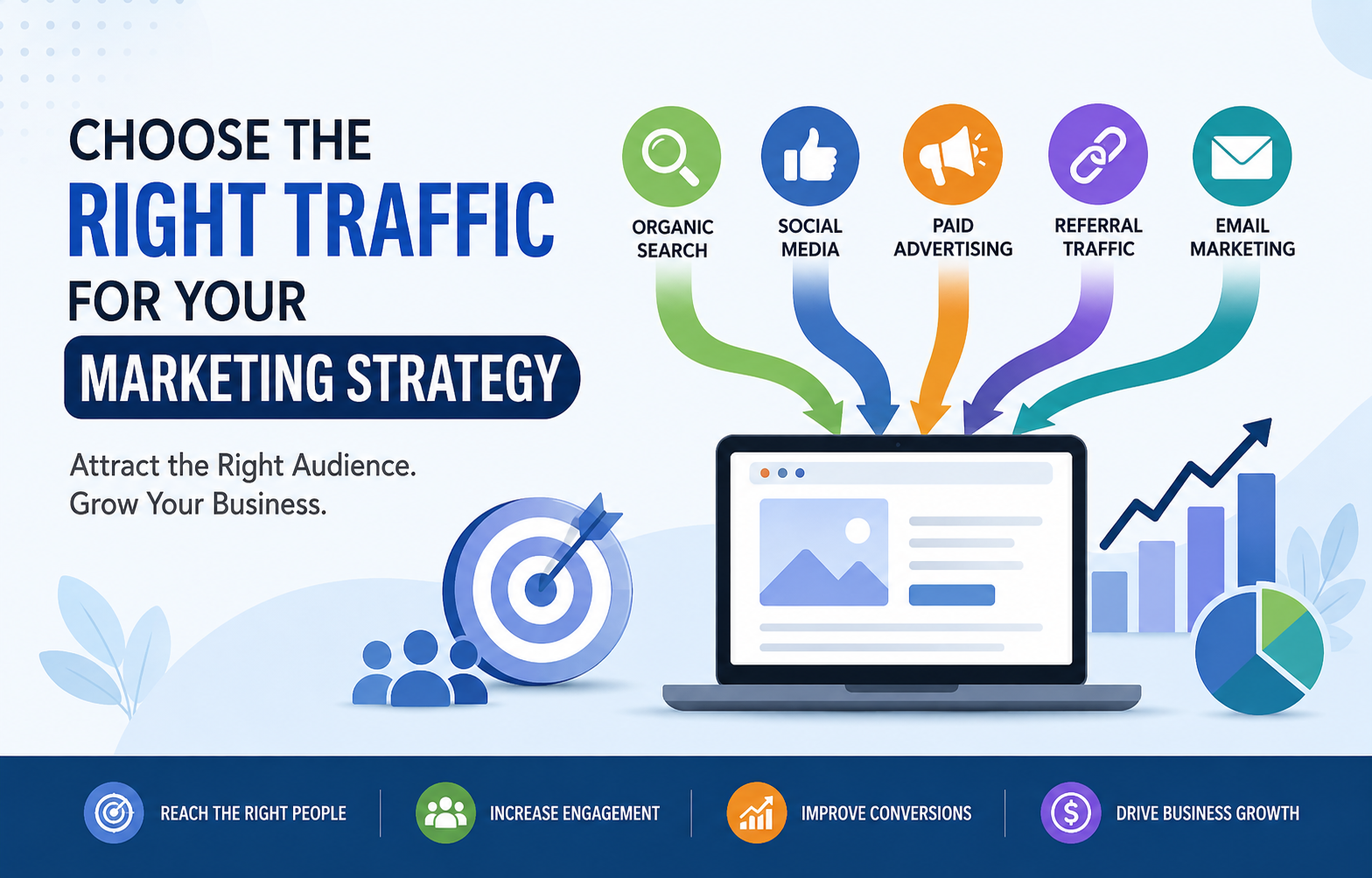
Getting more website visitors sounds like a straightforward marketing goal, but traffic alone does not determine whether a campaign is successful.
A website can receive thousands of visitors and still generate very few meaningful results if those visitors are not interested in what the business offers. On the other hand, a smaller audience with a strong interest in a product, service, or topic can be much more valuable.
That is why marketing should focus on attracting the right traffic, not simply the largest amount of traffic.
The right traffic depends on your audience, business model, content, budget, and goals. In this guide, you will learn how to evaluate different traffic sources and build a practical strategy for attracting visitors who are more likely to find your website useful.
What Does “The Right Traffic” Mean?
The right traffic refers to visitors who are relevant to what your website provides.
For example, imagine a website that publishes detailed tutorials about web development. Traffic from people actively searching for programming tutorials is generally more relevant than traffic from people who have no interest in technology.
Relevant traffic can lead to useful outcomes such as:
- Reading an article
- Subscribing to a newsletter
- Downloading a resource
- Contacting a business
- Purchasing a product
- Returning to the website
- Sharing useful content
The exact goal depends on the website.
The key principle is simple:
Do not optimize only for visitors. Optimize for visitors who have a reason to care about your content or offer.
Why Traffic Quality Matters in Marketing
Marketing involves connecting a message, product, or service with an appropriate audience.
If the audience is poorly matched, even well-designed content may perform poorly.
For example, consider two campaigns:
Campaign A: 10,000 visitors with little connection to the website’s topic.
Campaign B: 1,000 visitors who are actively interested in the website’s subject.
Campaign B may provide more meaningful engagement despite having fewer visitors.
This does not mean that smaller traffic is always better. It means that traffic volume and traffic quality should be evaluated together.
Traffic Should Match Your Goal
Before choosing a traffic source, define what you want visitors to do.
Different goals may require different strategies.
| Marketing Goal | Potential Traffic Sources |
|---|---|
| Build long-term visibility | Search engines, content marketing |
| Reach a new audience | Social media, partnerships |
| Promote a time-sensitive offer | Paid advertising, email |
| Generate business inquiries | Search, referrals, targeted advertising |
| Build an audience | Content, social media, email |
| Educate potential customers | Search, blogs, video, educational content |
These are general examples rather than universal rules. The best combination depends on the business and its audience.
1. Organic Search Traffic
Organic search traffic comes from people discovering your website through unpaid search results.
Search can be particularly useful when people are already looking for information, products, or solutions related to your website.
When organic traffic makes sense
Organic search can be a strong option for websites that can consistently publish useful content around topics their audience searches for.
For example, a technology website might create content around:
- Software tutorials
- Product comparisons
- Troubleshooting guides
- Educational articles
- How-to guides
- Industry explanations
Benefits
- Can provide long-term visibility
- Helps people discover content while searching
- Can attract visitors with specific interests
- Does not require paying for every individual visit
Limitations
Organic search usually takes time to develop. Search visibility can also change as search engines update their systems and as competitors publish new content.
For that reason, SEO should be viewed as a long-term marketing activity rather than an instant traffic solution.
2. Social Media Traffic
Social media can help websites reach people based on interests, communities, content, and relationships.
Different platforms attract different audiences and support different types of content.
A business should therefore avoid trying to maintain every social platform simply because it exists.
How to choose a social platform
Consider:
- Where your target audience spends time
- What type of content you can produce consistently
- Whether your topic works better with video, images, text, or discussions
- How much time you can realistically dedicate to the platform
For example, a visual brand may benefit from image- or video-focused platforms, while a professional B2B company may find professional networking channels more relevant.
Benefits
- Can help build an identifiable audience
- Supports direct interaction
- Makes content easier to distribute
- Can complement other marketing channels
Limitations
Social platforms control their own algorithms, formats, and distribution systems. Reach can therefore vary, and a business should avoid depending entirely on one platform.
3. Paid Advertising Traffic
Paid advertising allows businesses to pay for exposure through advertising platforms.
Depending on the platform, advertisers may be able to target audiences using factors such as search queries, interests, demographics, location, or previous interactions.
Paid advertising can be useful when a business needs controlled distribution and has a clearly defined audience.
Before spending money
Do not begin with the question:
“How much traffic can I buy?”
Start with:
“Who should see this advertisement, and why would they find the landing page useful?”
Then consider:
- Audience
- Advertising objective
- Landing page
- Budget
- Ad creative
- Measurement
- Conversion goal
Benefits
- Can provide faster exposure than many organic strategies
- Allows campaigns to be measured
- Can target specific audiences
- Makes it possible to test different messages
Limitations
Paid traffic requires a budget. Results can also vary depending on competition, targeting, advertising quality, landing-page experience, and the specific platform.
Never assume that paying for more traffic automatically produces better marketing results.
4. Referral Traffic
Referral traffic comes from visitors who reach your website through another website, publication, community, or online resource.
For example, a relevant website might mention your educational article and link to it because it provides additional information.
Why referral traffic can be valuable
A referral can introduce your website to an audience that already has an interest in a related subject.
The relevance of the referring source matters.
A link or mention from a website that serves an audience similar to yours may be more useful than exposure from an unrelated website.
How to build referral traffic naturally
Focus on creating resources that are genuinely useful and worth mentioning.
Examples include:
- Original guides
- Research summaries
- Useful tools
- Educational resources
- Industry explanations
- Well-organized reference pages
The goal should be to earn attention because the content is useful, not to pursue irrelevant exposure simply to increase visitor numbers.
5. Email Traffic
Email can be useful for websites that have permission to communicate with an interested audience.
Unlike search or social media, email allows a business to communicate directly with subscribers who have chosen to receive messages.
Good uses for email marketing
A website might use email to share:
- New articles
- Educational resources
- Product updates
- Company announcements
- Relevant offers
- Helpful recommendations
The content should provide a clear reason for subscribers to open and read the message.
Important consideration
Email marketing should respect applicable privacy, consent, and anti-spam requirements. Businesses should also provide appropriate ways for recipients to manage or unsubscribe from communications where required.
How to Choose the Right Traffic Source
Choosing a traffic source becomes easier when you evaluate it systematically.
Step 1: Define Your Target Audience
Start by identifying who you want to reach.
Consider:
- Their interests
- Their problems
- Their needs
- Their level of knowledge
- What information they search for
- Where they discover information
Avoid defining your audience only as “everyone.”
A more specific audience description makes marketing decisions easier.
Step 2: Define Your Goal
Your goal could be:
- Increasing brand awareness
- Growing an audience
- Generating inquiries
- Selling products
- Promoting content
- Building an email list
- Increasing returning visitors
Different goals can require different traffic strategies.
Step 3: Match the Traffic Source to User Intent
User intent describes what someone is trying to accomplish.
Someone searching for:
“How to fix a slow laptop”
has a different intent from someone searching for:
“Best laptop for programming.”
The first person may primarily want troubleshooting information. The second may be researching a purchase.
Understanding this difference helps marketers create more relevant content and landing pages.
Step 4: Consider Your Resources
Your marketing strategy should match what you can realistically maintain.
Ask:
- Do I have time to create content?
- Do I have an advertising budget?
- Can I produce videos?
- Can I write detailed articles?
- Do I have an existing audience?
- Can I measure results accurately?
A strategy that cannot be maintained is unlikely to be useful in the long term.
Step 5: Test and Measure
Avoid assuming that a traffic source will work simply because it worked for another business.
Start with a reasonable test and measure meaningful results.
Useful metrics can include:
- Relevant page views
- Engagement
- Returning visitors
- Leads
- Purchases
- Newsletter subscriptions
- Cost per acquisition
- Conversion rate
The appropriate metric depends on the marketing objective.
Traffic Volume vs Traffic Quality
One of the most common marketing mistakes is treating visitor numbers as the only important measurement.
Traffic volume tells you how many visits you received.
Traffic quality asks a different question:
Did the visitors find what they were looking for?
For example, if a website receives 5,000 visitors but almost everyone leaves immediately because the page does not match their expectations, simply increasing traffic may not solve the underlying problem.
A better approach is to investigate:
- Where visitors came from
- What they expected
- Which pages they viewed
- Whether the content answered their questions
- Whether they returned
- Whether they completed the desired action
This produces more useful information for future marketing decisions.
A Simple Traffic Strategy for Beginners
If you are starting a website or small online business, you do not need to use every traffic channel at once.
A simple approach might look like this:
Phase 1: Build useful content
Create genuinely helpful pages that answer specific questions from your target audience.
Phase 2: Establish one primary discovery channel
Choose one major source, such as organic search or a social platform, based on where your audience is most likely to discover your content.
Phase 3: Add a secondary channel
Once the primary process is manageable, consider adding email, social distribution, referrals, or paid advertising.
Phase 4: Measure performance
Look beyond visitor counts. Identify which sources produce the most relevant engagement or desired actions.
Phase 5: Improve
Invest more effort in approaches that demonstrate useful results and adjust approaches that do not.
Common Traffic Mistakes to Avoid
Chasing traffic from unrelated audiences
Large numbers are not necessarily useful if visitors have no interest in your subject.
Depending on one platform
Search engines and social platforms can change their algorithms, policies, and distribution systems. Building multiple appropriate channels can reduce dependence on one source.
Buying low-quality traffic
Traffic should not be evaluated solely by its price. Extremely cheap visitors may have little relevance to your website’s actual audience.
Ignoring the landing page
A successful advertisement or search result can still lead to poor results if the destination page is confusing, slow, irrelevant, or difficult to use.
Measuring the wrong metric
If your goal is to generate inquiries, page views alone may not tell you whether the campaign is working.
How Marketing and Traffic Work Together
Traffic is only one part of marketing.
A basic marketing system can be viewed as:
Audience → Traffic Source → Content or Offer → Landing Page → Desired Action → Measurement
If one part is poorly matched, the overall result can suffer.
For example, an excellent article may receive little traffic because it is difficult to discover. Conversely, a well-promoted page may perform poorly if it does not answer the visitor’s question.
Effective marketing therefore requires alignment between the audience, message, traffic source, and destination.
Frequently Asked Questions
1. What is the best traffic source for marketing?
There is no single best traffic source for every business. The right choice depends on the target audience, marketing objective, budget, content type, and available resources.
2. Is organic traffic better than paid traffic?
Neither is universally better. Organic traffic can support long-term visibility, while paid advertising can provide controlled and potentially faster exposure. Many businesses can use both as part of a broader strategy.
3. How do I know if my website traffic is good?
Look at more than visitor numbers. Consider whether visitors are relevant to your audience and whether they engage with your content or complete the action that matters to your website.
4. Should a new website use multiple traffic sources?
A new website can start with one primary traffic source and gradually add others. Trying to manage too many channels at the beginning can spread resources too thin.
5. Can social media traffic replace SEO?
Social media can complement SEO, but relying on one channel is not always advisable. Search and social platforms work differently, and each can provide different opportunities for reaching an audience.
Conclusion
Choosing the right traffic is an important part of effective marketing. The objective should not simply be to attract the largest possible number of visitors. Instead, businesses and website owners should focus on reaching people who are genuinely relevant to their content, products, or services.
Organic search, social media, paid advertising, referral traffic, and email can all play useful roles. The best combination depends on your audience, goals, resources, and ability to measure results.
Start by defining your audience and objective. Choose a traffic source that matches them, create a useful experience for visitors, measure meaningful outcomes, and improve the strategy based on what you learn.
When traffic and audience intent are aligned, marketing becomes more focused, measurable, and useful for both the website and its visitors.